
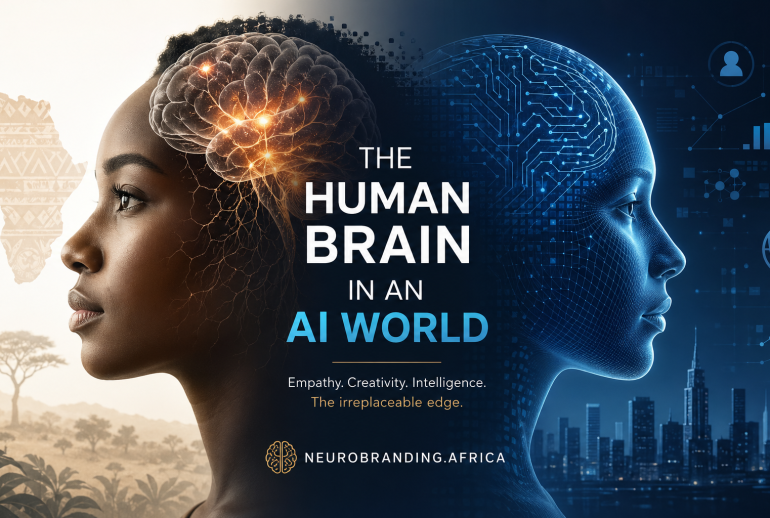
Artificial intelligence is transforming how marketing is created.
Content can now be generated faster, scaled instantly, and optimised continuously. Across industries, brands are producing more messages than ever before.
Yet one critical element has not evolved at the same pace:
The human brain.
While technology accelerates, human cognition remains fundamentally the same. Attention is limited. Memory is selective. Decisions are largely shaped by subconscious processes.
Research highlighted by Gerald Zaltman of Harvard Business School suggests that up to 95% of purchasing decisions are driven subconsciously. Similarly, Daniel Kahneman explains in Thinking, Fast and Slow that much of human thinking operates through fast, intuitive systems rather than deliberate reasoning.
This creates a growing imbalance:
- Content is increasing exponentially
- Human attention is not
- Cognitive filtering is becoming stronger
In this environment, brands are not competing on volume.
They are competing on how effectively they are processed by the brain.
What this means in an African context
Across African markets, this dynamic becomes even more pronounced.
Consumers navigate a hybrid landscape where:
- Global digital content meets strong local cultural influence
- Mobile-first behaviours dominate access to information
- Trust is often built through human interaction and community validation
In many cases, decision-making is not driven purely by formal information, but by:
- What feels familiar
- What feels credible
- What others around them trust
This means that while AI is increasing exposure to content, the filters through which people interpret that content remain deeply human and relational.
👉 Brands that fail to understand this risk, becoming visible — but not chosen.
The NeuroBranding Perspective
At NeuroBranding Academy Africa, we focus on helping organisations understand how the brain filters, simplifies, and decides — and how this translates into real-world brand strategy.
Because in an AI-driven world, the advantage no longer lies in producing more.
It lies in being understood faster.
Further Reading
- Thinking, Fast and Slow – Daniel Kahneman
- How Customers Think – Gerald Zaltman
- Harvard Business Review – Customer behaviour insights