
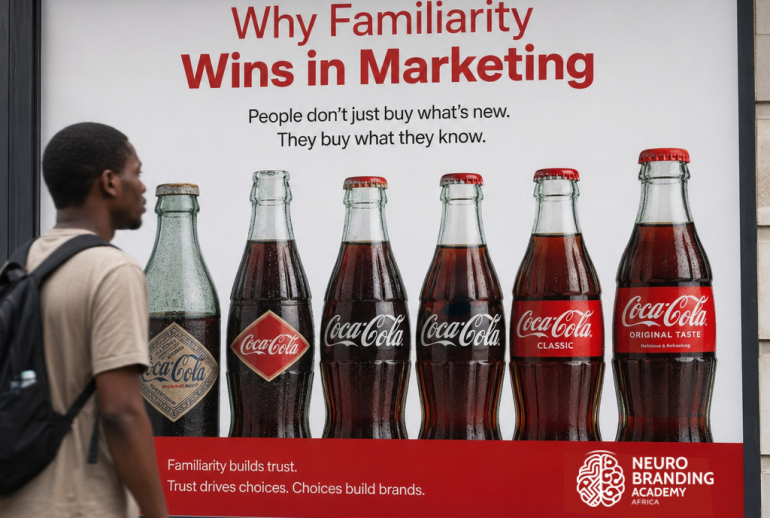
In competitive markets, brands often focus on persuasion; crafting messages, refining positioning, and seeking differentiation.
Yet one of the most powerful drivers of brand choice is far simpler:
Familiarity.
The human brain is designed to conserve energy. Processing new information requires effort. Recognising something familiar does not.
This is known as cognitive fluency — the ease with which information is processed.
Research by Robert Zajonc on the Mere Exposure Effect demonstrates that repeated exposure increases preference, even without conscious awareness.
Similarly, Byron Sharp in How Brands Grow highlights the importance of mental availability — the likelihood of a brand being noticed and recalled in buying situations.
This explains why:
- Consistent brands outperform inconsistent ones
- Repetition builds trust
- Simplicity enhances preference
👉 The easiest brand to recognise becomes the easiest to choose.
What this means in an African context
In many African markets, familiarity plays an even more critical role.
Consumers often operate in environments where:
- Information can be fragmented
- Brand claims may be difficult to verify instantly
- Switching carries perceived risk
In such contexts, familiarity becomes a form of risk reduction.
- Known brands feel safer
- Visible brands feel more credible
- Repeated exposure builds reassurance over time
This is why brands with strong physical and digital presence — from outdoor advertising to mobile platforms — tend to dominate mental space.
👉 Familiarity is not just a marketing outcome.
It is a signal of trust and reliability.
The NeuroBranding Perspective
NeuroBranding focuses on building brands that are:
- Easy to recognise
- Easy to recall
- Easy to trust
Because in real decision environments, customers are not comparing every option.
They are choosing what feels most familiar.
Further Reading:
How Brands Grow by Byron Sharp:
Mere Exposure Effect by Robert Zajonc:
https://humanperformance.ie/the-mere-exposure-effect/#:~:text=Final%20Thoughts-,Understanding%20the%20Mere%20Exposure%20Effect,%E2%80%9Cthere’s%20safety%20in%20numbers%E2%80%9D.