
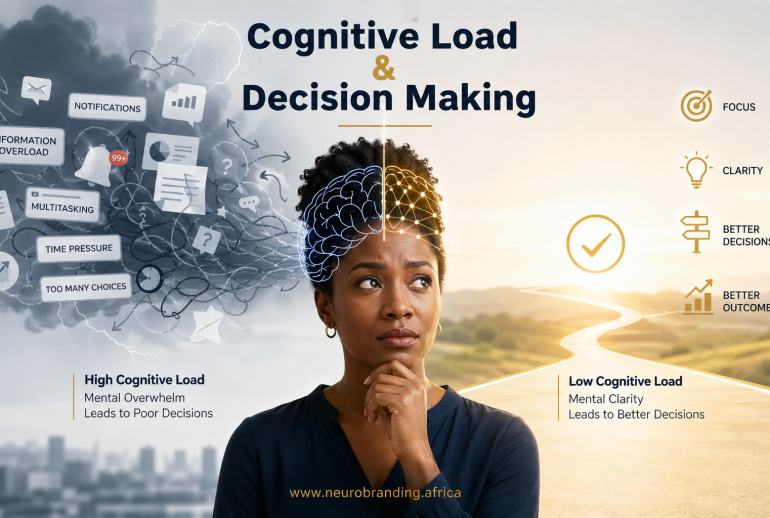
Modern consumers are not lacking information.
They are overwhelmed by it.
This leads to a fundamental concept in behavioural science:
Cognitive Load.
Cognitive load refers to the mental effort required to process information. When this effort becomes too high, the brain does not analyse more — it simplifies.
In marketing, this has profound implications.
When customers face:
- Too many choices
- Complex messaging
- Unclear value propositions
They do not engage more deeply.
👉 They disengage.
Research by Sheena Iyengar and Mark Lepper shows that reducing choice increases the likelihood of decision-making. Similarly, Daniel Kahneman explains that the brain naturally avoids effort and prefers simplicity.
This is why:
- Clear brands outperform complex ones
- Structured communication builds trust
- Simplicity increases conversion
What this means in an African context
In many African urban environments, cognitive load is amplified.
Consumers are exposed to:
- Dense advertising environments (OOH, mobile, social)
- Multiple languages and communication styles
- Rapidly growing digital ecosystems
At the same time, decision-making often happens quickly — in transit, on mobile devices, or in high-distraction environments.
This means:
- Messages must be instantly clear
- Visual recognition becomes critical
- Simplicity drives effectiveness
Brands that require too much thinking are often ignored.
👉 In this context, clarity is not just good communication.
It is a competitive advantage.
The NeuroBranding Perspective
NeuroBranding focuses on reducing cognitive load:
- Simplifying communication
- Enhancing clarity
- Designing for intuitive understanding
Because the brands that win are not those that say more —
they are those that are easier to process.
Further reading:
Thinking, Fast and Slow – Daniel Kahneman